

CV and resume are two terms you will often see when applying for a job. Sometimes they mean different things, but employers also use them to describe the same type of document.
That is why the difference can be confusing.
The simple explanation is that a resume is usually a short document tailored to a specific job, while a CV is traditionally a more detailed record of your academic and professional background.
However, what an employer means can also depend on the country, industry, and type of position.

What is a resume?
A resume is a short summary of your relevant skills, experience, and education.
It usually includes:
- Contact information
- A professional summary
- Work experience
- Education
- Skills
- Relevant achievements or certifications
A resume is commonly one or two pages long. It focuses on the information that is most relevant to the job you are applying for.
For example, if you are applying for a marketing role, your resume should highlight your marketing experience, campaigns, results, and related skills. You do not need to give the same amount of attention to experience that is less relevant.
This means you may have slightly different versions of your resume for different roles. Your experience stays the same, but you adjust what you highlight based on what each employer needs.
What is a CV?
CV stands for curriculum vitae, which roughly means “course of life.”
Traditionally, a CV is a detailed document covering your professional and academic history. It may include:
- Education and qualifications
- Employment history
- Research experience
- Publications
- Teaching experience
- Awards and grants
- Conferences and presentations
- Professional memberships
A traditional CV can be several pages long because its purpose is to provide a more complete record.
This type of document is most commonly used when applying for positions in academia, research, medicine, and other specialist fields.
Why are the terms often confused?
The meaning of CV and resume is not the same everywhere.
In the United States and Canada, a resume is normally used for most job applications. A CV is generally expected for academic, research, or medical positions.
In many other countries, CV is the more common term for a regular job application document—even when that document is only one or two pages long.
Employers may therefore ask for a CV when they are actually expecting what others would call a resume. In everyday hiring, the two words are often used interchangeably.
So, seeing “submit your CV” does not always mean you need to prepare a long and detailed document.
For further reading, Harvard’s career guidance explains the traditional difference between a resume and a CV, while the European Commission’s Europass guidance shows how a CV can be tailored to a particular job in Europe.
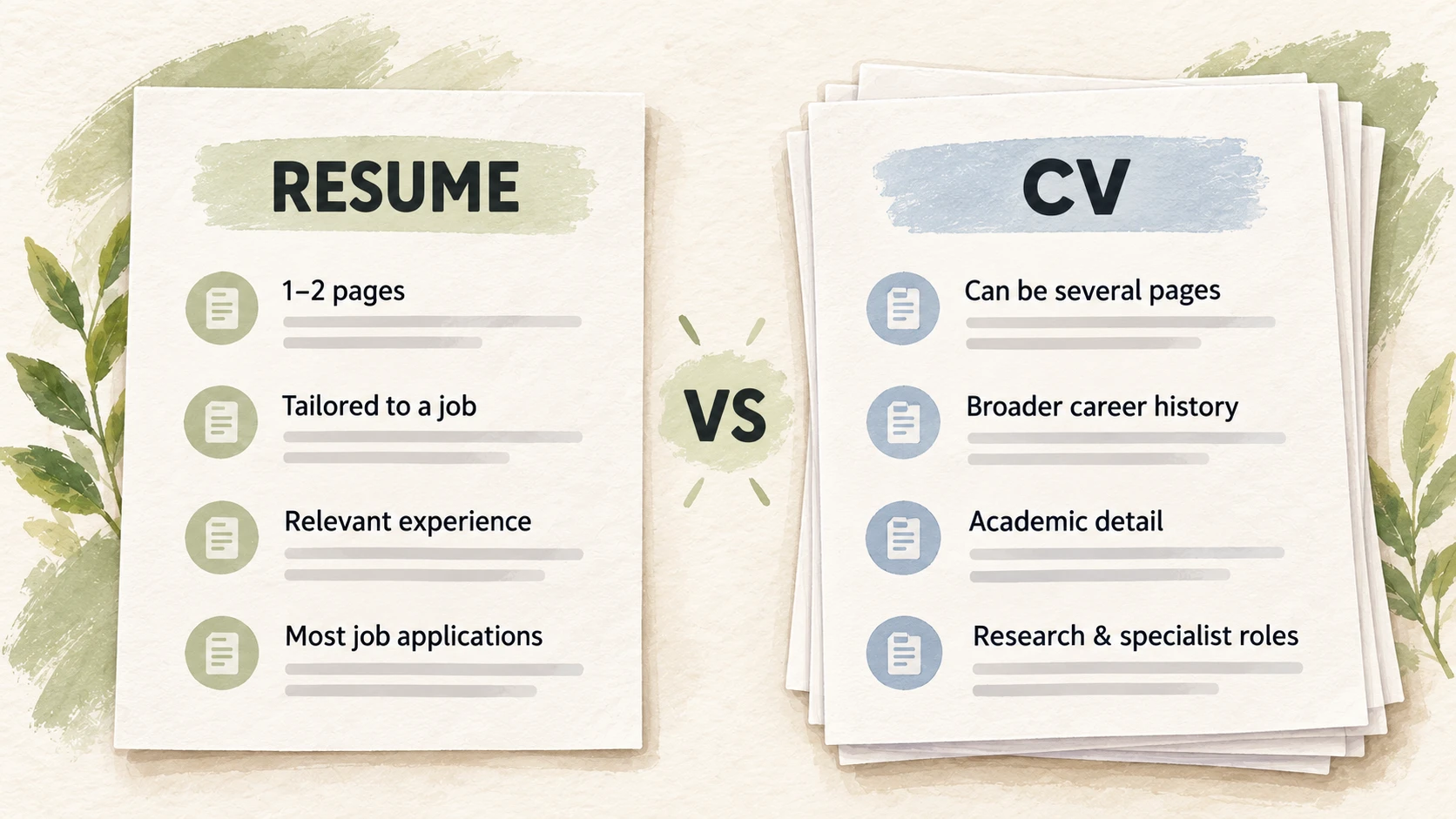
CV vs resume at a glance
Resume
- Usually one or two pages
- Tailored to a specific job
- Focuses on relevant skills and experience
- Used for most job applications
- Adjusted for different roles
Traditional CV
- Can be several pages
- Covers a broader professional history
- Includes detailed academic and professional information
- Common in academia, research, and specialist fields
- Grows as you gain qualifications and experience
Which one should you use?
Always begin with the job advertisement.

If it asks for a resume, send a short document focused on the role.
If it asks for a CV, consider the type of position. An academic or research role may require a traditional, detailed CV. For a regular business or industry role, the employer may simply be using CV as another name for a resume.
You can also look for additional instructions. A page limit, required sections, or a request for publications and research experience can help you understand what the employer expects.
If you are still unsure, it is perfectly reasonable to ask the recruiter.
Should you tailor your document for every job?
You do not need to create a completely new document every time you apply, but you should review it before sending it.
Make sure the most relevant information is easy to find. Highlight the experience and skills that match the position, and remove details that do not help the employer understand your suitability.
This does not mean changing or exaggerating your experience. It simply means presenting truthful information in a way that is useful to the reader.
A clear and relevant document is usually more effective than a longer one filled with unnecessary details.
Keep your CVs and resumes organised
Different roles may need different versions of your CV or resume. As those versions add up, it can become difficult to remember which document is current and which one you sent.
This is where BylineCV can help. It keeps your career documents organised and accessible across devices, so you can spend less time managing files and more time preparing for your applications.
What matters more than the name?
Whether the employer calls it a CV or a resume, the document should clearly explain:
- What experience you have
- What skills you can offer
- What you have achieved
- Why your background is relevant to the role
Keep the layout easy to read, use clear language, and make sure your information is accurate and up to date.
The name of the document matters less than whether it gives the employer the information they need.
So, is a CV the same as a resume?

Not exactly, although the terms are often used interchangeably.
A resume is usually short and tailored to a particular job. A traditional CV is longer and provides a more detailed account of your academic and professional history.
When deciding which one to send, pay attention to the role, the employer’s instructions, and the information they are asking for.
The goal is simple: provide a clear document that helps the employer understand your experience and what you can offer.